
The year 2026 is shaping up to be one of the most significant milestones in the history of consumer electronics, specifically for the Apple ecosystem. For years, critics and enthusiasts alike have speculated about when the Cupertino giant would finally embrace the foldable revolution and what the next true “supercycle” for the iPhone would look like. Based on supply chain leaks, analyst reports from the likes of Ming-Chi Kuo and Jeff Pu, and Apple’s own patent filings, the 2026 Apple lineup is expected to be a radical departure from the iterative updates we have seen recently. With the anticipated launch of the iPhone 18 series and the debut of the first Apple Foldable, 2026 will likely be the year Apple redefines the premium smartphone market.
The Evolution of the iPhone 18 Series: Beyond Iteration
While the foldable device will undoubtedly steal many headlines, the iPhone 18 will remain the volume driver for Apple. Historically, Apple follows a three-year major redesign cycle, and 2026 falls perfectly into the window where we expect significant architectural and aesthetic shifts. The iPhone 18 lineup is expected to maintain the four-model strategy—standard, Plus (or potentially “Slim/Air”), Pro, and Pro Max—but the internals will be anything but standard.
The most significant leap for the iPhone 18 will be the transition to 2nm processor technology. Currently, Apple is utilizing 3nm processes, but by 2026, TSMC (Apple’s primary chip manufacturer) is expected to have perfected the 2nm “GAA” (Gate-All-Around) transistor architecture. This shift is crucial for several reasons:
- Increased Efficiency: A 2nm chip will allow for significantly better battery life even if battery sizes remain the same.
- Processing Power: Higher transistor density means the A20 Bionic chip will be capable of handling complex AI tasks locally rather than relying on the cloud.
- Thermal Management: Smaller nodes generally run cooler, allowing for sustained performance during intensive gaming or video editing.
The Camera Revolution: Variable Aperture Technology
For the first time in the history of the iPhone, rumors suggest that the iPhone 18 Pro and Pro Max will feature a variable aperture main camera. While competitors like Samsung and Xiaomi have experimented with this in the past, Apple’s implementation is expected to focus on seamless integration with its computational photography engine. A variable aperture would allow the camera to mechanically adjust the size of the lens opening, providing users with:
- Natural Bokeh: The ability to create a shallow depth-of-field without relying solely on software-based Portrait Mode.
- Low Light Excellence: Opening the aperture wider (e.g., f/1.4) to let in more light during nighttime shooting.
- Sharper Landscapes: Narrowing the aperture for landscape photography to ensure edge-to-edge sharpness.
Furthermore, we expect the 48MP sensor technology to trickle down to all lenses—wide, ultra-wide, and telephoto—across the Pro models, ensuring consistent color science and resolution regardless of the focal length chosen.
The Arrival of the Apple Foldable: iPhone Flip or Foldable iPad?
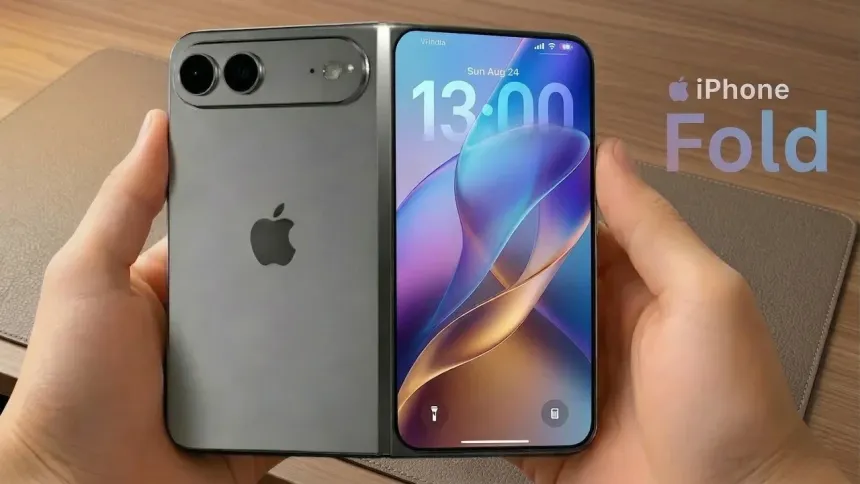
The most anticipated device of 2026 is, without question, the first Apple Foldable. While there has been debate over whether this would be an “iPhone Flip” (clamshell) or a “Foldable iPad” (book-style), recent reports suggest Apple is prioritizing a clamshell design that feels like a premium iPhone but folds into a compact square. This device is internally referred to as a project that seeks to solve the “crease” problem that has plagued competitors for years.
Apple’s entry into the foldable market is not about being first; it is about being the most refined. Reports indicate that Apple is working with Samsung Display and LG Display to develop a screen that uses a specialized chemical treatment to reduce light reflection and increase durability. Key features of the 2026 foldable are expected to include:
- Self-Healing Display: Apple has filed patents for a display material that can “heal” minor scratches and dents through heat or external stimuli.
- No-Gap Hinge: A proprietary hinge mechanism that allows the device to fold completely flat without a visible gap, protecting the inner screen from dust.
- External Notification Screen: Much like the Dynamic Island, the exterior of the foldable will likely feature a high-refresh-rate “cover” display for quick interactions.
Under-Display Face ID and the Death of the Notch
By 2026, Apple is expected to have mastered the technology required for Under-Display Face ID. This would allow the iPhone 18 Pro models to move away from the pill-shaped Dynamic Island cutout in favor of a true all-screen design. While a small hole-punch for the selfie camera may remain for one more generation, the sensors required for 3D facial recognition will be hidden beneath the pixels of the OLED panel.
This transition is more than just an aesthetic choice; it represents a fundamental change in how users interact with their devices. With more screen real estate, iOS 20 (the likely operating system for the 2026 lineup) will be able to implement new multitasking features that were previously cramped on smaller displays. For the foldable model, this technology is even more critical, as it ensures an immersive experience when the device is fully unfolded.
Apple Intelligence 3.0: The AI-First Era
The hardware of the iPhone 18 and the Foldable will be built to serve Apple Intelligence. By 2026, Apple’s AI suite will have moved past its introductory phase. We expect the 2026 lineup to feature 12GB of RAM as the minimum for Pro models to support large language models (LLMs) running natively on the device.
The synergy between the A20 chip and Apple Intelligence will likely focus on “Proactive Assistance.” Imagine an iPhone that anticipates your needs based on your location, biometric data from your Apple Watch, and your calendar, performing complex tasks like “organizing a travel itinerary and booking Uber rides” through simple voice commands to a revamped Siri. For the foldable, AI will play a role in continuity—seamlessly shifting an app’s interface and functionality as you transition from the small cover screen to the large internal display.
Design and Build: The Rise of Titanium and New Materials
Apple revolutionized its design language with the introduction of Grade 5 Titanium on the iPhone 15 Pro, and for the 2026 lineup, we expect this to evolve further. The iPhone 18 Pro will likely use an even lighter, more scratch-resistant Titanium-Aluminum hybrid. There are also rumors of Apple experimenting with Ceramic Shield 2.0, which would offer four times the drop resistance of current models.
For the foldable, weight is the primary concern. Apple is reportedly looking at carbon fiber components for the internal chassis to ensure the device doesn’t feel overly heavy in the pocket. The goal is to make the folded device no thicker than two current iPhones stacked together, a feat of engineering that requires incredible precision.
Connectivity and the 6G Horizon
While 6G is not expected to be commercially available until 2030, the iPhone 18 will likely feature the most advanced 5G Advanced (5.5G) modems, likely produced by Qualcomm or potentially Apple’s own long-rumored in-house modem. This will provide better connectivity in crowded areas and improved satellite communication capabilities. Wi-Fi 7 will also be standard across the entire 2026 lineup, allowing for near-instantaneous file transfers and lower latency for AR/VR applications using the Apple Vision Pro.
Battery Life and Charging: A New Standard?
The 2026 lineup might finally see the introduction of stacked battery technology. This technology, borrowed from the electric vehicle industry, allows for higher energy density and faster charging speeds without increasing the physical footprint of the battery. We expect the iPhone 18 Pro Max to push the boundaries of smartphone endurance, potentially offering 30+ hours of video playback. Furthermore, with the EU’s regulations on USB-C and battery replaceability, Apple may introduce a more modular internal design that makes battery swaps easier for authorized technicians, if not the users themselves.
Pricing and Market Position
With these massive technological leaps, pricing remains a point of speculation. The iPhone 18 is expected to maintain its entry price of approximately $799, but the Apple Foldable will undoubtedly sit at the top of the pyramid. Industry analysts predict the foldable could start anywhere from $1,499 to $1,999, positioning it as a luxury productivity tool rather than a mass-market device.
The 2026 lineup will likely consist of:
- iPhone 18: The balanced flagship for the average user.
- iPhone 18 Slim/Air: A ultra-thin model focused on design.
- iPhone 18 Pro & Pro Max: The powerhouses for creators and professionals.
- iPhone Fold: The new halo product representing the future of the brand.
Conclusion: The Dawn of a New Era
The 2026 Apple lineup represents a “perfect storm” of technological convergence. The maturity of foldable display technology, the arrival of 2nm chips, and the full integration of generative AI are all set to collide in September 2026. For consumers, this means the choice between the most refined version of the classic slab smartphone and the bold new world of foldables.
While we are still some time away from the official unveiling, the roadmap is clear. Apple is no longer just selling a phone; they are selling an AI-driven personal companion that can change its shape to fit the user’s needs. Whether you are a photography enthusiast waiting for the variable aperture of the iPhone 18 Pro or a tech visionary waiting to get your hands on the iPhone Fold, 2026 promises to be the most exciting year for Apple fans in over a decade. The wait for the next big thing is almost over, and it looks like it will be worth it.