Introduction: The New Global Tech Battlefield
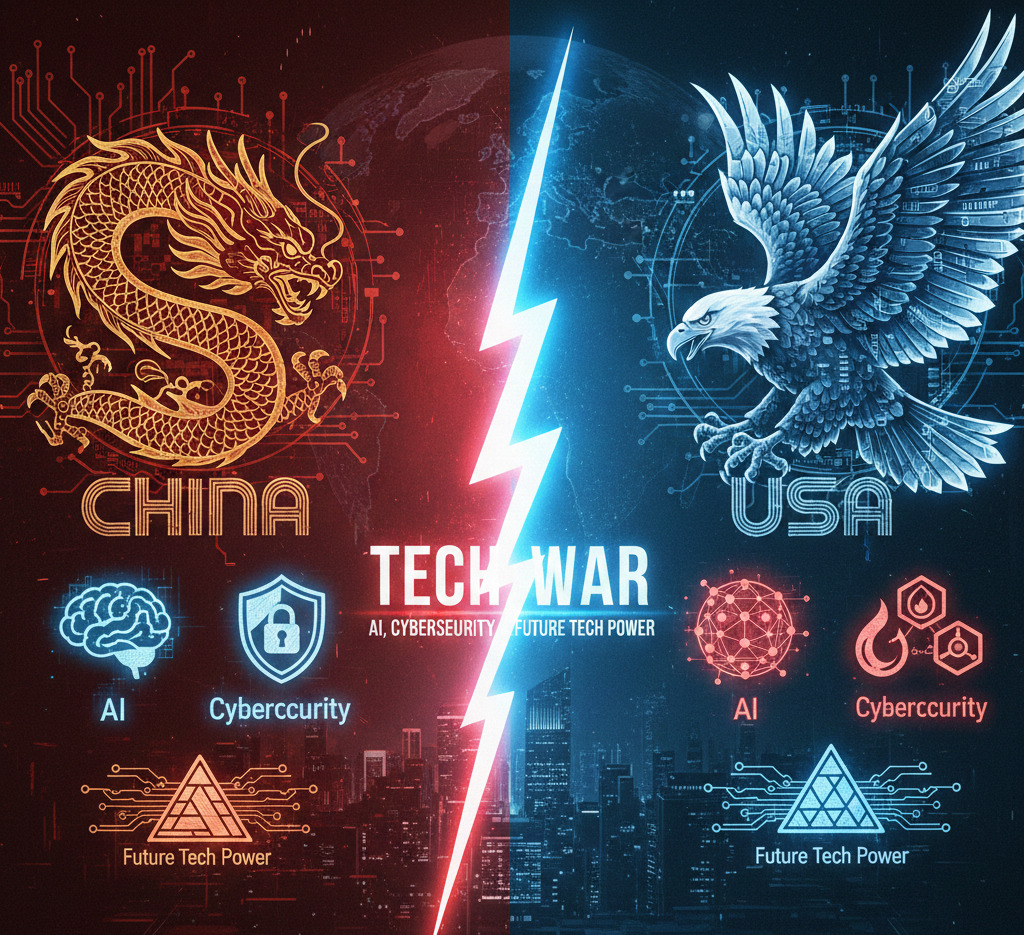
Technology has become the most powerful weapon of the 21st century. Unlike past wars fought with guns and soldiers, today’s global competition is driven by artificial intelligence, semiconductors, 5G networks, cloud computing, electric vehicles, and space technology. At the center of this technological battlefield stand two superpowers: the United States and China.
The USA has long been seen as the birthplace of modern innovation—home to Silicon Valley, Apple, Google, Microsoft, Amazon, Tesla, and OpenAI. China, once known mainly for manufacturing and imitation, has rapidly transformed into a technology powerhouse, producing global giants like Huawei, Alibaba, Tencent, BYD, and DJI.
This is not just a competition between companies. It is a system-level clash between two different models of innovation:
- The USA’s open-market, startup-driven ecosystem
- China’s state-backed, long-term strategic technology planning
This article explores—deeply and honestly—who is winning the tech race, where each country dominates, where they lag behind, and what this rivalry means for developers, businesses, and everyday users around the world.
1. Philosophy of Innovation: How the USA and China Build Technology
United States: Bottom-Up Innovation
The American technology ecosystem is built on:
- Venture capital
- University research
- Startup culture
- Freedom to fail
Most breakthrough innovations in the USA start small:
- A college project (Google, Facebook)
- A garage startup (Apple)
- A research lab experiment (OpenAI, NVIDIA)
Key strengths:
- Strong intellectual property laws
- Independent private companies
- World-class universities (MIT, Stanford, Harvard)
Weaknesses:
- Short-term profit pressure
- Political instability affecting policy
- Dependence on global supply chains
Source:
https://www.brookings.edu/articles/how-america-innovates/
China: Top-Down Strategic Innovation
China follows a very different approach. The government plays a direct role in shaping technological progress.
Key features:
- Massive government funding
- Long-term national tech plans (Made in China 2025)
- State-backed research institutions
- Rapid scaling and execution
Strengths:
- Fast infrastructure deployment
- Huge domestic market for testing tech
- Strong manufacturing integration
Weaknesses:
- Limited transparency
- Concerns about IP protection
- Global trust and regulation issues
Source:
https://www.csis.org/analysis/chinas-technology-strategy
2. Semiconductor & Chip War: The Heart of Modern Technology
Semiconductors are the brain of every modern device—from smartphones to AI supercomputers and fighter jets.
USA’s Position in Chip Technology
The USA dominates:
- Chip design
- Advanced AI processors
- Semiconductor software (EDA tools)
Key players:
- NVIDIA (AI GPUs)
- Intel (CPUs)
- AMD (high-performance processors)
- Qualcomm (mobile chips)
However, the USA does not manufacture most chips domestically. Fabrication depends heavily on:
- TSMC (Taiwan)
- Samsung (South Korea)
This dependency is a major strategic weakness.
Source:
https://www.semiconductors.org/chips/
China’s Semiconductor Challenge
China is aggressively trying to build a self-sufficient chip industry.
Major efforts:
- SMIC (China’s largest foundry)
- Billions in government subsidies
- Reverse engineering + domestic talent development
Current reality:
- China is still behind in 3nm and 5nm manufacturing
- Heavy impact from US export restrictions
But progress is real—and fast.
Source:
https://www.reuters.com/technology/chinas-chip-industry-explained/
3. Artificial Intelligence: OpenAI vs Baidu vs Alibaba
AI is the most critical technology race of the century.
USA: Global AI Leader (For Now)
The USA leads in:
- Foundational AI models
- Research papers
- AI infrastructure
Top organizations:
- OpenAI (ChatGPT, GPT models)
- Google DeepMind
- Meta AI
- Microsoft Azure AI
Strengths:
- Open research culture
- Best AI talent pool
- Massive computing resources
Challenges:
- Regulation debates
- Ethical and privacy concerns
- High development cost
Source:
https://aiindex.stanford.edu/report/
China: AI at National Scale
China focuses on:
- Facial recognition
- Surveillance AI
- Smart cities
- Industrial AI
Major players:
- Baidu (Ernie Bot)
- Alibaba Cloud AI
- Tencent AI Lab
- SenseTime
China’s AI advantage:
- Access to massive datasets
- Government-supported deployment
- Rapid real-world testing
Limitation:
- Less openness
- Restricted global adoption
Source:
https://www.nature.com/articles/d41586-023-01716-9
4. 5G, 6G & Telecom: Huawei vs Qualcomm
China’s Telecom Dominance
China leads the world in:
- 5G infrastructure
- Telecom equipment deployment
Huawei:
- Global leader in 5G patents
- Strong R&D investment
- Competitive pricing
Despite sanctions, Huawei continues to innovate domestically.
Source:
https://www.gsma.com/technology/5g/
USA’s Telecom Strategy
The USA focuses more on:
- Chipsets (Qualcomm)
- Software-defined networks
- Security-first infrastructure
Weakness:
- Slower 5G rollout
- Reliance on private carriers
Strength:
- Strong standards leadership
- Global alliances
Source:
https://www.fcc.gov/5G
5. Smartphones & Consumer Technology
USA: Premium Innovation
Apple dominates:
- High-end smartphone market
- Ecosystem integration
- Software optimization
Strengths:
- Brand loyalty
- Security & privacy focus
- Long software support
Weakness:
- High prices
- Manufacturing dependence on China
Source:
https://www.counterpointresearch.com/
China: Volume & Variety King
Chinese brands:
- Xiaomi
- Oppo
- Vivo
- Huawei
Strengths:
- Affordable innovation
- Fast hardware upgrades
- Massive global reach (Asia, Africa, Europe)
Weakness:
- Software fragmentation
- Limited US market access
Source:
https://www.statista.com/topics/840/smartphones/
6. Cloud Computing & Big Data
USA: Cloud Superpower
Leaders:
- Amazon Web Services (AWS)
- Microsoft Azure
- Google Cloud
Strengths:
- Global infrastructure
- Enterprise trust
- Advanced AI integration
Source:
https://www.gartner.com/en/information-technology/insights/cloud-computing
China: Domestic Cloud Giant
Leaders:
- Alibaba Cloud
- Tencent Cloud
- Huawei Cloud
Strengths:
- Dominant inside China
- Government integration
- Smart city infrastructure
Limitation:
- Limited global adoption due to trust issues
Source:
https://www.alibabacloud.com/solutions
PART 2: Cybersecurity & Surveillance Technology (Deep Technical Analysis)
7. Cybersecurity: The Invisible Digital Battlefield
Cybersecurity has become one of the most critical and dangerous arenas in the China vs USA technology rivalry. Unlike AI or smartphones, cyber warfare happens silently—without borders, without public announcements, and often without proof.
Both countries officially deny offensive cyber operations, yet global cybersecurity researchers consistently identify state-linked cyber activities originating from both the United States and China.
This is not just hacking. This is cyber-espionage, cyber-defense, cyber-deterrence, and cyber-dominance.
7.1 USA’s Cybersecurity Ecosystem
The United States leads the world in cybersecurity research, commercial security tools, and offensive cyber capabilities.
Core Strengths of the US Cyber Model
- Private-Sector Dominance
- Most cybersecurity innovation comes from private companies, not the government.
- The government partners with companies rather than controlling them.
- Advanced Security Tooling
- Endpoint detection and response (EDR)
- Zero Trust architecture
- Cloud-native security
- AI-powered threat detection
- Global Cyber Standards
- US companies define many international cybersecurity frameworks and tools.
Major US Cybersecurity Companies
Some of the world’s most advanced cybersecurity companies are US-based:
- Palo Alto Networks – enterprise firewalls & cloud security
- CrowdStrike – AI-powered endpoint security
- Fortinet – network security appliances
- Zscaler – zero trust cloud security
- Microsoft Defender – enterprise-scale integrated security
These tools protect:
- Governments
- Financial institutions
- Cloud platforms
- Military systems
- Global corporations
Source:
https://www.gartner.com/en/information-technology/insights/cybersecurity
NSA & US Cyber Command
Behind the commercial layer exists the United States Cyber Command (USCYBERCOM) and the National Security Agency (NSA).
Their responsibilities include:
- Defensive cyber operations
- Offensive cyber capabilities
- Intelligence gathering
- Protection of national infrastructure
The USA is believed to possess:
- Advanced zero-day exploits
- Cyber-physical attack capabilities (e.g., Stuxnet-style operations)
- Global surveillance access via allied intelligence networks (Five Eyes)
Source:
https://www.cybercom.mil/
7.2 China’s Cybersecurity Strategy
China’s cybersecurity model is state-centric, centralized, and tightly integrated with national policy.
Unlike the US, where private companies lead, China’s cybersecurity ecosystem is deeply connected to the government.
China’s Cybersecurity Priorities
- Data Sovereignty
- All data generated in China must remain under Chinese jurisdiction.
- Foreign tech companies face strict data localization rules.
- National Firewall Architecture
- The Great Firewall is one of the most complex internet filtering systems ever built.
- Uses deep packet inspection (DPI), DNS poisoning, and traffic shaping.
- Internal Stability & Control
- Cybersecurity is tied to social stability, censorship, and political control.
Chinese Cybersecurity Companies
Major domestic players include:
- Qihoo 360 – endpoint and network security
- Huawei Cyber Security – telecom and infrastructure security
- Venustech – enterprise security solutions
- NSFOCUS – vulnerability management
These companies primarily serve:
- Government agencies
- State-owned enterprises
- Critical infrastructure
Source:
https://www.csis.org/analysis/chinas-cyber-capabilities
Alleged Chinese Cyber Operations
Western cybersecurity firms have repeatedly accused Chinese state-linked groups of:
- Intellectual property theft
- Industrial espionage
- Supply-chain attacks
- Long-term persistent access campaigns (APT groups)
Commonly referenced groups:
- APT41
- APT10
- Mustang Panda
China denies these claims and accuses the USA of global cyber surveillance hypocrisy.
Source:
https://www.fireeye.com/current-threats/apt-groups.html
8. Surveillance Technology: Ethics vs Efficiency
Surveillance technology is where the ideological gap between the USA and China becomes most visible.
Both countries use advanced surveillance tools—but how and why they use them differs dramatically.
8.1 Surveillance Technology in China
China has built the largest surveillance system in human history.
Core Components of China’s Surveillance Stack
- Facial Recognition
- AI-powered face detection at national scale
- Used in airports, streets, malls, offices
- Smart City Infrastructure
- Millions of CCTV cameras
- Real-time monitoring
- Automated alerts
- Behavioral Analytics
- Pattern recognition
- Predictive policing
- Social behavior monitoring
- Biometric Integration
- Face
- Voice
- Gait recognition
Social Credit System (Technology Perspective)
From a purely technical standpoint, China’s social credit system integrates:
- Big data platforms
- AI decision engines
- Real-time scoring models
While controversial, it represents one of the most advanced large-scale data integration systems ever deployed.
Source:
https://www.bbc.com/news/world-asia-china-34592186
Chinese Surveillance Tech Companies
- Hikvision – world’s largest CCTV manufacturer
- Dahua Technology – AI-powered surveillance hardware
- SenseTime – facial recognition AI
- Megvii – computer vision platforms
These companies lead globally in:
- Hardware efficiency
- Real-time AI processing
- Cost-effective deployment
Source:
https://www.reuters.com/technology/china-surveillance-technology/
8.2 Surveillance in the United States
The USA also operates massive surveillance systems—but in a more fragmented and legally constrained way.
US Surveillance Structure
- Government Surveillance
- NSA metadata collection
- Lawful intercept programs
- Court-approved monitoring
- Corporate Surveillance
- Data collected by Google, Meta, Amazon, Apple
- Advertising-driven data models
- Law Enforcement Technology
- Facial recognition (limited)
- License plate readers
- Phone metadata analysis
Edward Snowden Revelations
The Snowden leaks revealed:
- Mass data collection programs
- Global surveillance partnerships
- Metadata monitoring at scale
Afterward, the USA introduced:
- Stronger legal oversight
- Transparency reports
- Privacy-first product marketing
Source:
https://www.aclu.org/issues/national-security/privacy-and-surveillance
9. Cybersecurity vs Surveillance: Who Is Ahead?
Technical Capability Comparison
| Area | USA | China |
|---|---|---|
| Offensive Cyber | Very Strong | Strong |
| Defensive Cyber | Very Strong | Strong |
| AI Security Tools | Leading | Catching up |
| Mass Surveillance | Limited | Dominant |
| Privacy Protections | Stronger | Weak |
| Global Trust | Higher | Lower |
Key Insight (Very Important)
- USA leads in cybersecurity tools and defense
- China leads in surveillance scale and deployment
- Both countries sacrifice privacy—but in different ways
Why This Matters for Developers & Tech Professionals
If you are:
- A web developer
- A software engineer
- A cybersecurity analyst
- A startup founder
This rivalry directly affects:
- Cloud hosting rules
- Data privacy laws
- API access
- Open-source availability
- AI regulation
For example:
- US sanctions can block Chinese APIs
- Chinese firewalls can block US services
- Global platforms must choose compliance paths
Final Summary (Part 1 & Part 2)
The global technology race between China and the United States is no longer limited to smartphones, apps, or social media platforms. It has evolved into a multi-layered technological conflict that spans artificial intelligence, semiconductors, cloud computing, cybersecurity, surveillance systems, and national digital infrastructure.
From the analysis in Part 1, it is clear that the United States continues to lead in foundational innovation. American dominance in advanced semiconductor design, AI research, cloud platforms, and software ecosystems is powered by private-sector creativity, elite universities, open research culture, and strong venture capital networks. Companies like OpenAI, NVIDIA, Apple, Google, Microsoft, and Amazon define the global direction of software, AI, and enterprise technology.
China, however, has demonstrated unmatched strength in scaling technology at national and global levels. Through long-term government planning, massive funding, and tight integration between state and industry, China has built leadership in 5G infrastructure, telecom hardware, manufacturing efficiency, and consumer electronics volume. Chinese firms such as Huawei, Alibaba, Tencent, Xiaomi, and BYD have proven that speed, cost efficiency, and deployment scale can rival pure innovation.
In Part 2, the focus shifted to cybersecurity and surveillance technology, revealing the deepest ideological divide between the two nations. The United States leads in cyber defense, enterprise security tools, zero-trust architectures, and global cybersecurity standards, largely driven by private companies and regulated oversight. At the same time, US intelligence agencies maintain some of the world’s most advanced cyber capabilities, operating within legal frameworks shaped by democratic institutions.
China, on the other hand, has built the largest and most integrated surveillance ecosystem in human history, combining AI-powered facial recognition, biometric databases, smart cities, and real-time monitoring systems. While technically impressive, this system prioritizes state control and internal stability over individual privacy. In cybersecurity, China focuses heavily on data sovereignty, internal network protection, and national digital independence, often at the cost of global trust.
Overall, the comparison reveals a critical truth:
- The USA excels at creating technology
- China excels at deploying technology at scale
Neither country fully dominates the technology landscape. Instead, the future of global tech will likely be shaped by continued competition, partial decoupling, and regional technology ecosystems. For developers, businesses, and users worldwide, this rivalry will influence everything from cloud hosting rules and AI access to data privacy laws and software availability.